
1.6.1 Production in the EU-27
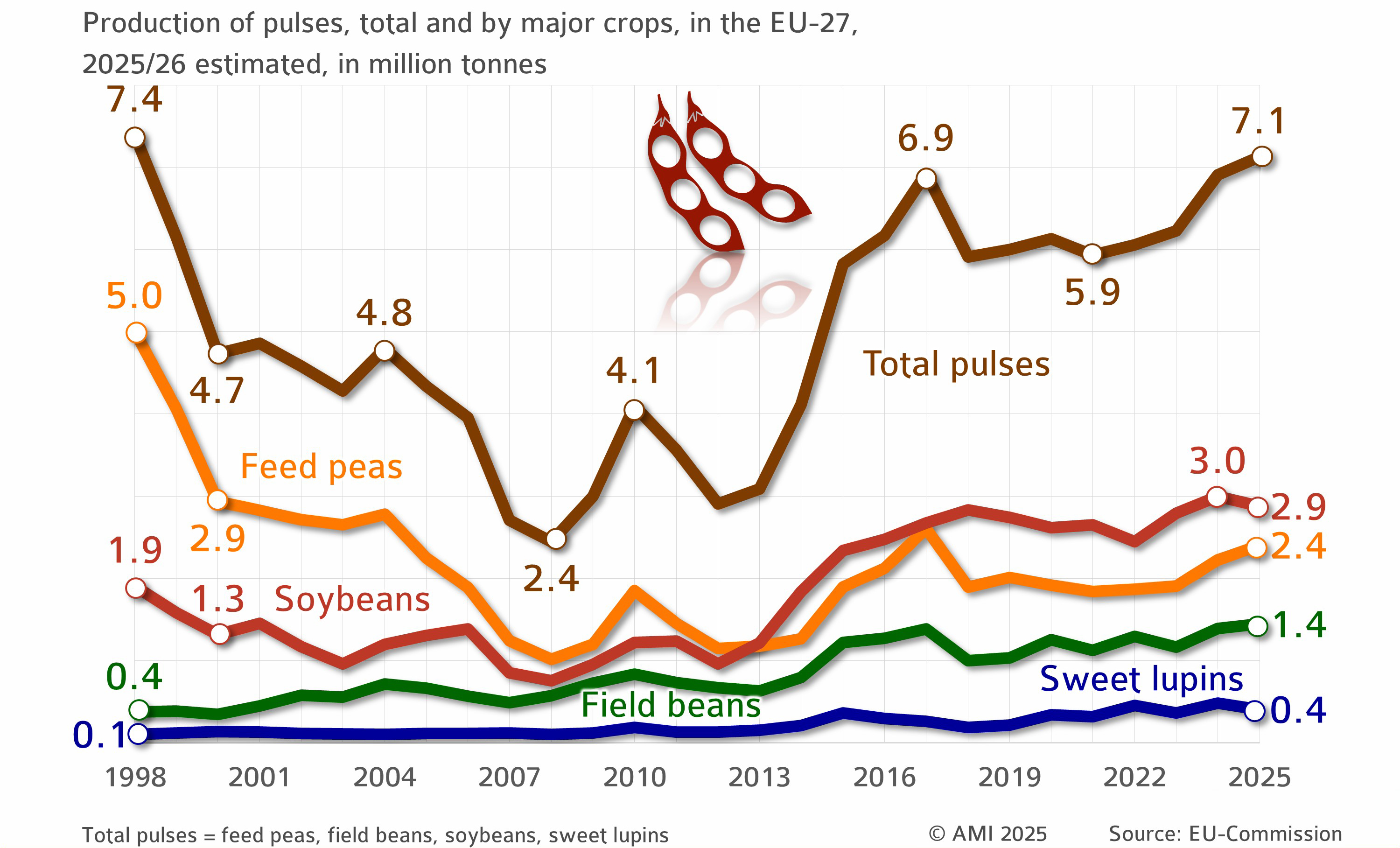
Pulse farming has become increasingly important in the EU-27 both for reasons of biodiversity – pulse crops perform important ecological functions as flowering plants – and in terms of climate change mitigation, as they do not require mineral nitrogen applications. Moreover, they hold potential as an alternative source of protein for innovative food products.
The European Commission expects production to reach roughly 7.1 million tonnes in 2025, representing an increase of approximately 3.2 per cent year-on-year and setting a new record. The rise in dry pea and broad bean harvests is expected to be particularly sharp. Production of dry peas is projected to reach 2.4 million tonnes and of broad beans 1.4 million tonnes, representing an increase of 8 per cent and 4 per cent respectively. Soybean remains the most important legume crop in the EU-27 in 2025, with output reaching just under 2.9 million tonnes, accounting for roughly 40 per cent of total grain legume production. However, the harvest will probably fall short of the previous year's level.
Notwithstanding their growing importance, domestic protein crops continue to compete with imported soybeans and soybean meal, which are often lower-priced and have high protein quality. Nonetheless, advances in grain legume breeding, production and processing demonstrate growing potential and represent a central pillar of the European protein plant strategy. The UFOP supports research and development projects and is ramping up public relations activities at EU level: see https://www.ufop.de/agrar-info/agrar/ and https://www.dieviervonhier.eu/ (both links in German only).
Production of pulses above previous year
1.6.2 Production in Germany
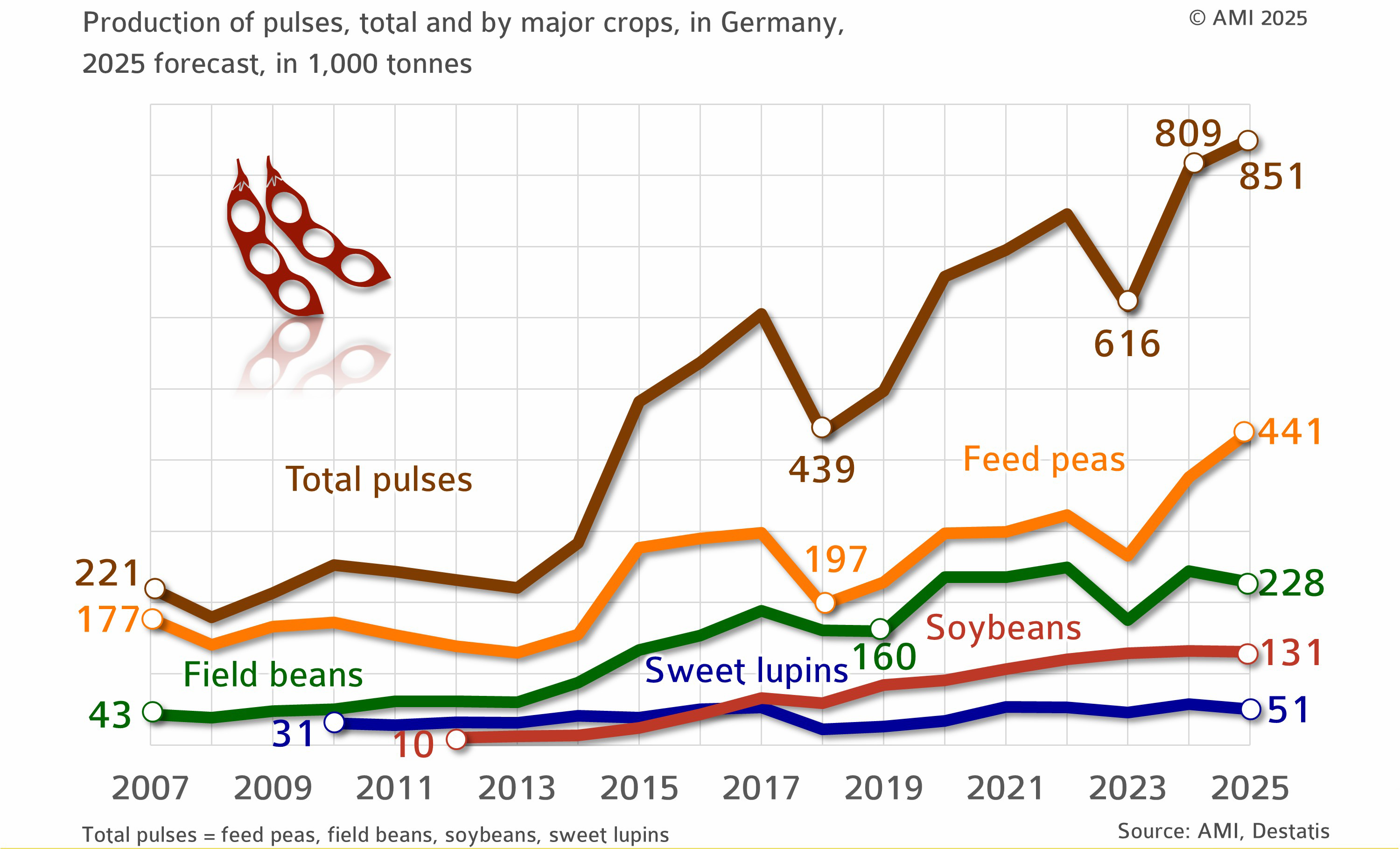
The legume harvest in Germany hit a new record in 2025. Based on preliminary information, it totalled 851,000 tonnes, marking a roughly 5 per cent increase year-on-year. Dry peas remain the most important grain legume crop with 441,100 tonnes and a significant increase of 17 per cent compared with the previous year. They are followed by broad beans, with production expected to remain around 6 per cent below last year's level at 228,400 tonnes. Sweet lupins recorded a 12 per cent drop to 50,500 tonnes. Soybeans are gaining importance. Despite an expansion in area, the harvest is expected to reach 130,800 tonnes, remaining just under 1 per cent below the previous year's level due to reduced yields.
Notwithstanding positive growth, pulse production remains at a relatively low level. A major factor in this is the poor competitive position compared with other field crops. However, grain legumes are essential for the diversification of crop rotation systems, the furtherance of biodiversity and the improvement of soil fertility. Due to the ability of their root nodule bacteria to fix atmospheric nitrogen, they make a significant contribution to climate protection. Over the long term, domestic pulses hold the potential to establish themselves more as an alternative source of protein on the market. This is why the UFOP is involved in the LeguNet joint project: https://www.legunet.de/english
Production of pulses on the rise
Headerbild: jorisvo – stock.adobe.com