1.4.1 Global use of grains
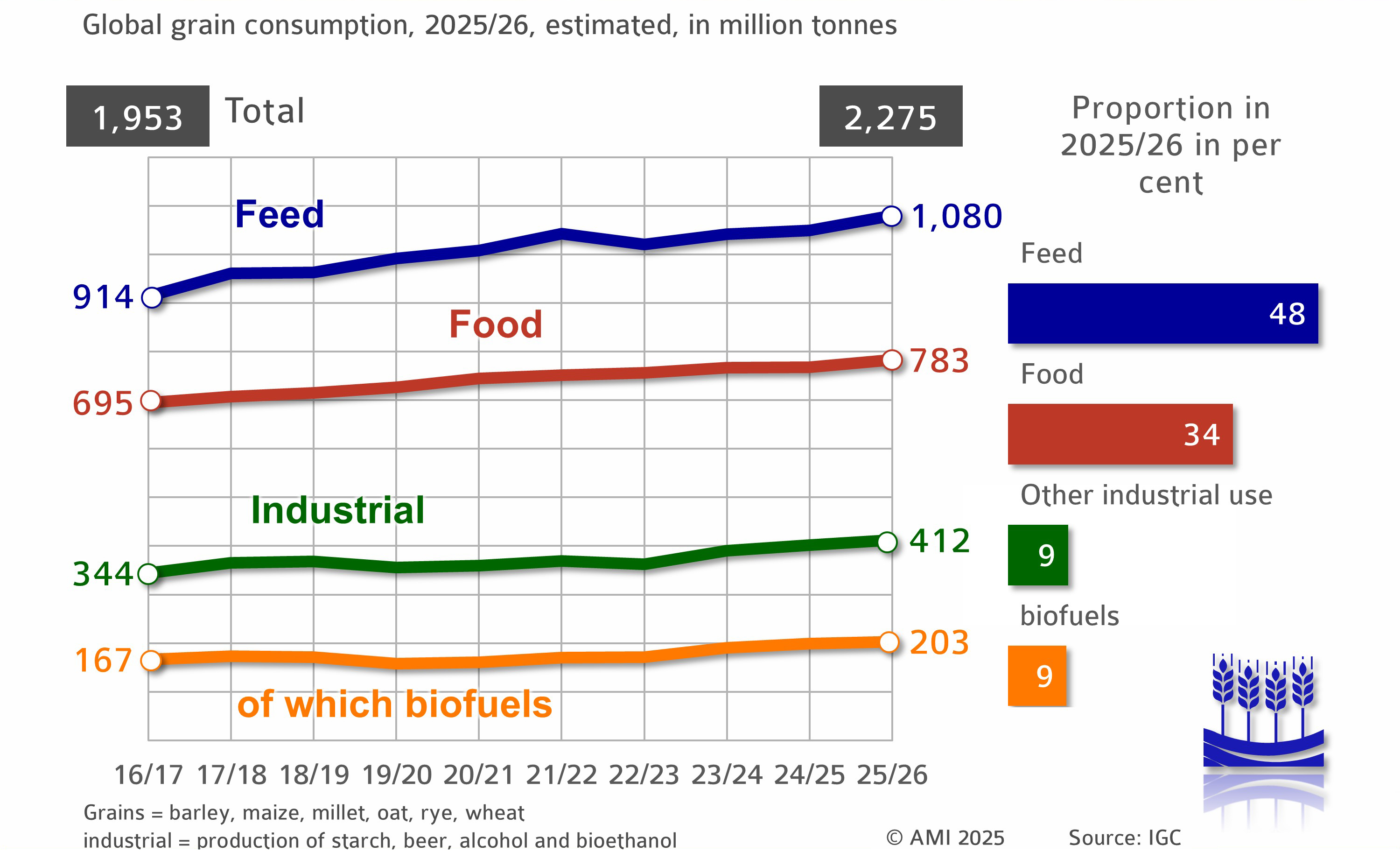
Global production of grains (excluding rice) in the 2025/26 crop year is forecast to reach 2.4 billion tonnes, which will be used in the human diet and, to a large extent (48 per cent), as animal feed. It is also used as a feedstock for industrial processing, particularly in bioethanol production.
The share used for feed will be largely stable compared to the previous years' levels. At 34 per cent, the use of grain for human consumption will remain the second most important type of use. Demand for grain for transport fuel production is expected to slightly increase again in 2025/26. According to the International Grains Council (IGC), however, it accounts for less than one-tenth of total consumption. This means that there is enough grain available for the feed and food markets.
In the US, bioethanol is mostly made from maize. Dried Distillers Grains with Solubles (DDGS) are obtained as a by-product and are a valuable protein feed. One tonne of wheat yields, on average, 295 kg of DDGS, and one tonne of maize yields 309 kg of DDGS. When grain prices are high, biofuel production is the first sector to be reduced before farmers begin to withhold on feed. Since food markets offer higher added value, grain stocks are preferentially used for food when prices are high. In other words, the biofuels market serves as a “supply buffer” between supply for human consumption and feed purposes.
Grain is mainly used for feed production