1.3.1 Production of grain
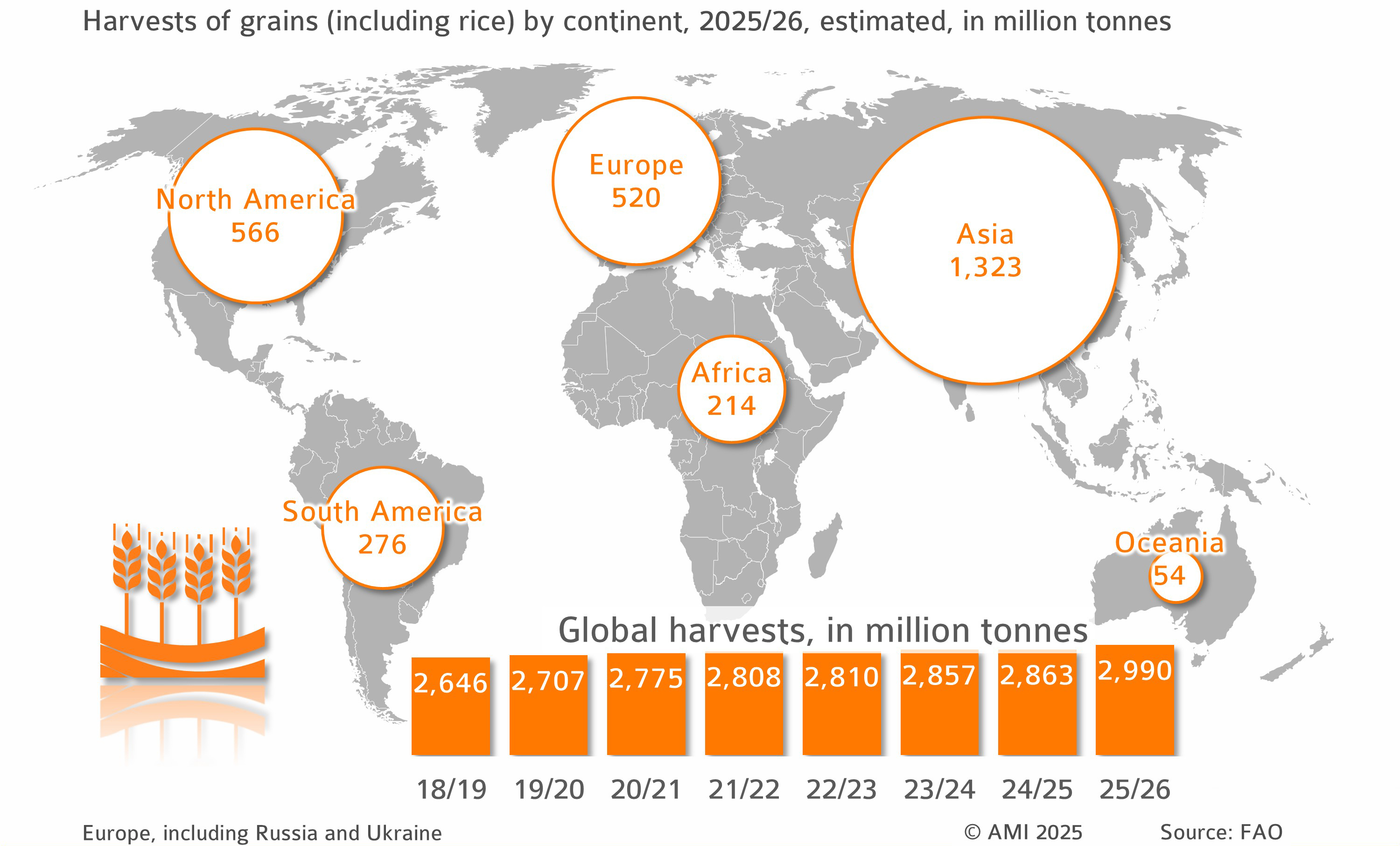
Global production of grain, including rice, is projected to increase for the seventh year running in 2025/26, presumably reaching a volume of 2,990 million tonnes according to information from the Food and Agriculture Organisation (FAO). This would mark a new record and represent a 4.4 per cent rise on the previous year. All major cereal crops are projected to achieve higher yields; the largest increase is expected for maize, and the smallest for rice.
At 44 per cent, Asia accounts for the largest share of global production, mainly due to the high concentration of rice production. Although China is the world's leading producer of grain and rice, exports are insignificant, as most of the harvest remains in the country for domestic consumption.
North America ranks second at 566 million tonnes, accounting for 19 per cent, of which the US contributes the largest share at 366 million tonnes. Europe follows closely behind at 520 million tonnes and a share of 18 per cent. Exports play a crucial role for countries like the US and Canada, whereas China, despite its large output, relies on imports.
Asia is the largest grain producer
1.3.2 Production of oilseeds
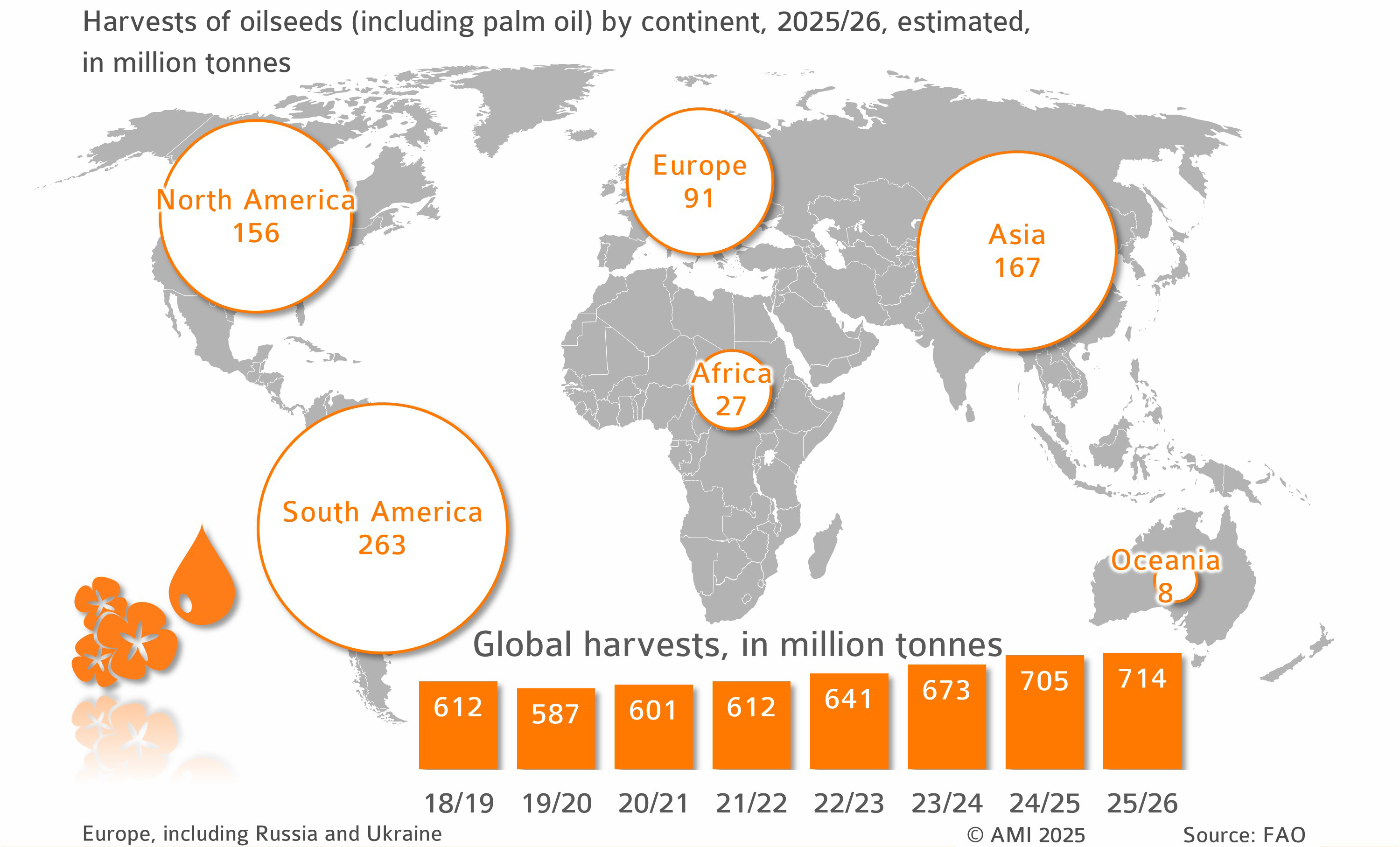
Global output of oilseed has risen significantly over the past six years. According to the FAO, it will probably reach 714 million tonnes in 2025/26, representing an increase of 1.3 per cent on the previous year. This growth is mainly due to an expansion of the area planted in South America. The EU Deforestation Regulation (EUDR) aims to prevent additional land being converted for agricultural use. A “proof of origin” is required to bring soybeans and soybean products to market.
Oilseed production is more evenly distributed across the world than grain production. However, regional importance differs notably. Soybean production predominates in South America and the US, whereas production in Canada and the EU-27 is mainly focused on rapeseed due to climate conditions. Sunflower production is very important in eastern Europe. Both soybeans and rapeseed are produced on a large scale in China and India. Oil palm is the primary oilseed crop in Malaysia and Indonesia.
This geographic diversity contributes to global security of supply, allowing partial offsets of national fluctuations in yield caused by phenomena such as El Niño or La Niña
Oilseed harvests at all-time high