
2.2.1 Global resource bases for biodiesel and HVO
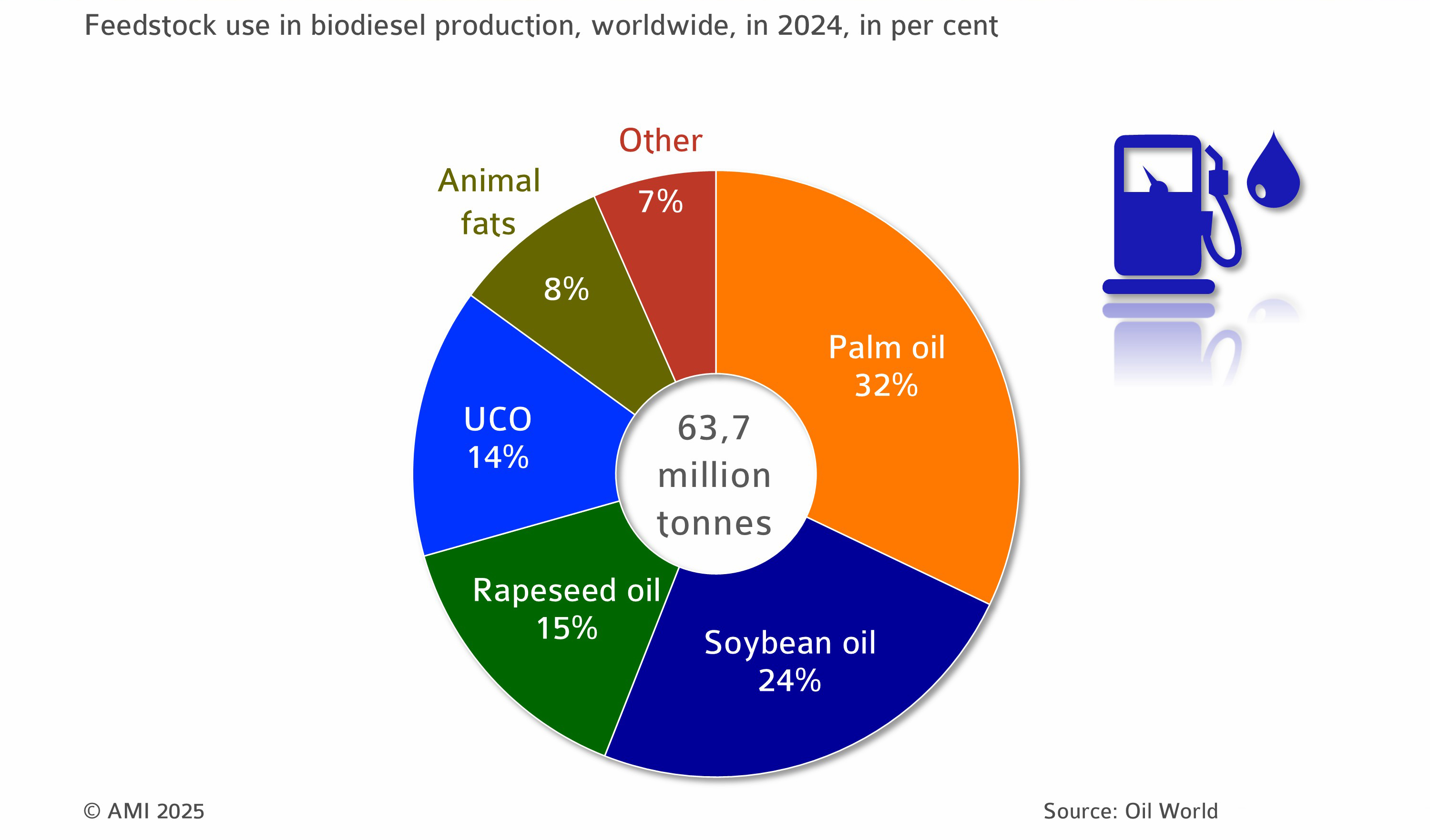
Production of biodiesel/HVO has increased all round the world, totalling 63.7 million tonnes in 2024. Feedstock requirements increased accordingly, rising nearly 7 per cent compared with 2023. The feedstock ranking remained unchanged, with palm oil accounting for the largest share (32 per cent), followed by soybean oil (24 per cent) and rapeseed oil (15 per cent). Used cooking oils and fats (UCO) reached 14 per cent, animal fats 8 per cent and other oils/fats 7 per cent. Their shares will likely continue to increase, because they also include effluent from palm oil mills (POME). In Brazil and Canada, production is expected to increase further in the months to come, whereas the US is anticipated to record a slight decline from the previous year's level.
The use of waste oils and fats is expected to increase further in the EU-27, especially at the expense of palm oil, which the European Commission has classified as a high iLUC-risk feedstock. As a result, biofuels derived from palm oil can no longer be credited towards quota obligations from 2030 onwards. In Germany, this has been the case since 1 January 2023. Other member states have also already excluded crediting of palm oil-based biofuels.
The importance of rapeseed oil as a feedstock in biodiesel and HVO production will continue to grow. Rapeseed remains an important feedstock for biodiesel fuel production in the winter half year (FAME), as rapeseed methyl ester (RME) has significantly better low-temperature properties than FAME derived from palm oil or animal fats. Accordingly, RME is preferably used in the cold season – also to enhance the quality of biodiesel made from used cooking oils (UCOME) – in order to meet specifications described in the EN 14214 standard for biofuels.
Palm oil is the world's most important raw material
Headerbild: jorisvo – stock.adobe.com