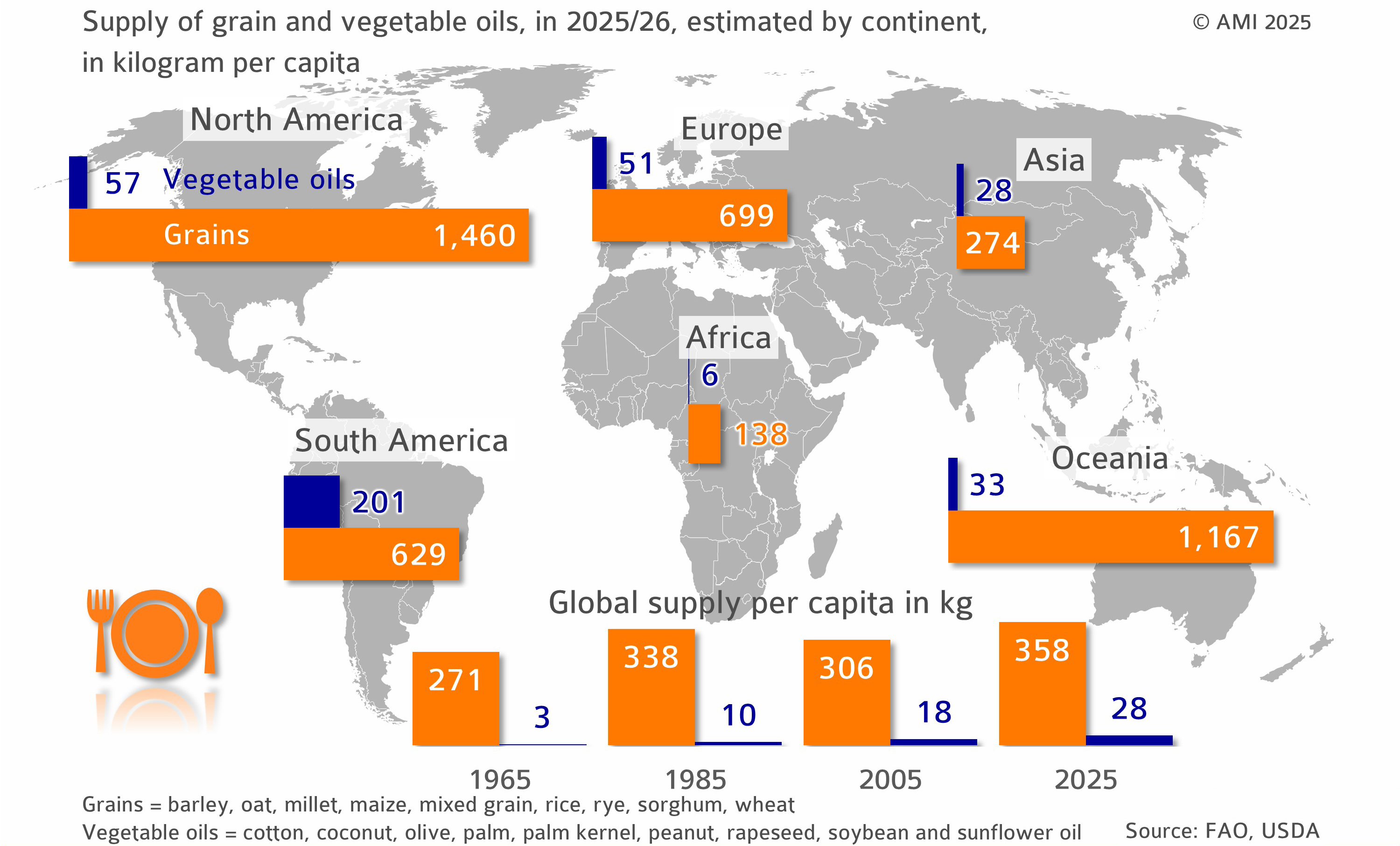
3.3.1 Supply per capita
For 2025/26, global per capita supply is expected to reach 358 kg in the case of grain and 28 kg in the case of vegetable oils. In other words, supply is projected to be well above the level recorded 20 years ago. The figures include the use of grain and vegetable oils for food, feed, biofuels, and other industrial purposes. It should be noted that feedstock intended for biofuel production can be diverted to other uses such as human nutrition at any time, if and when necessary. At the same time, the joint products generated in biofuel production, such as soybean meal and rapeseed meal, make an outstanding contribution towards producing high-quality food, thus reducing demand for meat or feedstuffs from other production regions. Production and use of oilseeds should be assessed in a holistic manner, taking into account their contribution towards food security, higher value added, and biodiversity. This is, in essence, the concept of a networked bioeconomy in action.
In purely arithmetic terms, food supply is sufficient to feed the world's population. However, there are still huge differences between regions. The differences mainly result from disparities in distribution and purchasing power as well as general political conditions and conflicts. Biofuel production therefore does not compete with food. Inadequate supply is more the result of political policies that are not guided enough by humanitarian values. The US government's irresponsible dismantling of foreign aid (USAID) is a cautionary example.
More vegetable oil available for Asia